How Do Automated Wafer Transfer Solutions Improve Manufacturing Consistency?
.jpg)
Semiconductor manufacturing leaves almost no room for variation. A microscopic particle, slight misalignment, or unnecessary manual touch can affect yield, increase rework, and slow production. As device geometries continue to shrink and fabs push for higher throughput, manufacturers are relying on automated wafer transfer solutions to keep production stable from one process step to the next.
Today's wafer transfer technology focuses on one simple objective - moving every wafer the same way, every time. That level of consistency reduces contamination, limits handling errors, and helps production lines deliver more predictable results. Their role has expanded beyond simple transportation - they now support process stability, equipment utilization, and long-term manufacturing consistency.
Why Consistency Matters More Than Ever
Every wafer follows hundreds of manufacturing steps before becoming a finished semiconductor device. If wafer positioning varies between tools or contamination occurs during movement, even the most advanced processing equipment cannot compensate for the resulting defects.
This is why manufacturers increasingly invest in wafer front end. Automation standardizes wafer movement, minimizes human intervention, and ensures every transfer follows the same motion profile regardless of production volume.
In today's high-volume fabs, repeatability has become just as valuable as speed.
How Automated Wafer Transfer Improves Manufacturing Consistency
The biggest advantage of automation is that it removes variables from wafer movement.
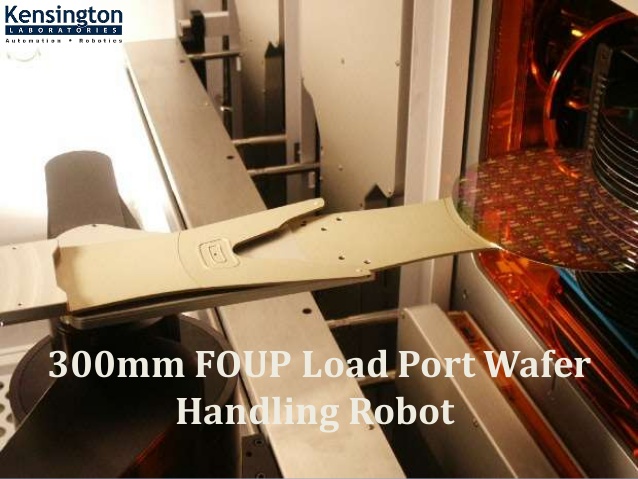
Instead of depending on manual handling, Kensington robot systems perform identical movements with extremely high positional accuracy. This creates a more predictable production environment where equipment receives wafers in the same orientation and condition every time.
Key benefits include-
- Reduced particle contamination caused by manual handling
- Consistent wafer alignment between process tools
- Lower risk of wafer breakage and edge damage
- Improved production throughput
- Better equipment utilization across the manufacturing line
When every transfer follows the same sequence, downstream processes become more stable and easier to optimize.
The Role of Front-End Automation
Modern fabs are expanding front-end automation well beyond robotic transport. Automated load ports, Equipment Front-End Modules (EFEMs), sensors, and factory software now work together as one connected system.
Rather than functioning independently, wafer transfer systems continuously exchange production data with manufacturing execution systems (MES), inspection equipment, and scheduling software.
This coordinated workflow delivers several operational advantages-

The result is a manufacturing environment where every production step becomes easier to monitor, measure, and improve.
Semiconductor Robotics Is Becoming Smarter
As chips become more sophisticated, the need for increased manufacturing becomes imperative. In order to compete, many chip makers are implementing robotics, predictive maintenance and real time monitoring of production to help keep their equipment up and running.
Today's semiconductor robotics platforms do much more than transport wafers. Advanced systems can-
- Detect transfer abnormalities before failures occur
- Monitor motion accuracy continuously
- Adjust operating parameters based on equipment status
- Support predictive maintenance schedules
- Integrate with digital factory control platforms
These capabilities help manufacturers maintain stable production without sacrificing throughput.
Better Wafer Handling Means Better Process Control
Consistent wafer movement directly supports stronger process control throughout fabrication.
When wafers arrive at each processing tool under identical conditions, engineers can identify true process variations instead of chasing inconsistencies introduced during transport.
Modern wafer handling systems contribute to-
- More repeatable process measurements
- Faster root-cause analysis
- Reduced equipment downtime
- Improved yield management
- Greater confidence in production data
As advanced packaging, EUV lithography and smaller process nodes demand tighter manufacturing tolerances, this level of control is becoming increasingly valuable. Trends in the industry also suggest an increasing use of integrated robotic handling, real-time monitoring and modular automation platforms to support next-generation semiconductor manufacturing.
Final Thoughts
Manufacturing consistency is based on thousands of actions repeated exactly. Automated wafer movement helps achieve that goal by reducing contamination, improving alignment accuracy and creating predictable production workflows.
Automated wafer transfer solutions will continue to be an integral part of efficient, high-yield manufacturing environments as semiconductor manufacturing evolves. Companies that need dependable automation technology are increasingly looking for solutions that combine precision engineering with lasting reliability. Kensington Laboratories is a leading provider of precision robotics and automation solutions to the semiconductor industry. They provide advanced motion control and robotic technologies that help manufacturers improve consistency, productivity and process performance across demanding fabrication environments.


Comments
Post a Comment